Why reflective markings matter on South African roads
In Johannesburg traffic, a company vehicle is often seen first from the rear, in wet spray, dust, or during early-morning and late-evening runs. Reflective striping and marked panels help other drivers judge a vehicle’s shape and width sooner, which matters when bakkies, vans and trucks are mixing with taxis, delivery bikes and heavy traffic. For fleet owners, that extra visibility is practical. It can reduce near misses at speed humps, along narrow estate roads and when reversing into busy loading areas.
Reflective graphics are also useful where load-shedding affects site lighting, or where a yard simply does not have enough light at the gate. A properly planned reflective layout gives a vehicle a clear outline from a distance, not just a bright patch on one panel. That makes it easier for security staff, pedestrians and other drivers to notice the vehicle before it is on top of them.
Where fleets get the most value from reflective film
Not every vehicle needs the same setup. The best results usually come from matching the marking to the job. A courier van in Sandton needs different visibility from a maintenance bakkie doing early calls in Midrand, and a panel van heading to Durban will face different weather and road conditions again. We normally look at route type, parking habits, night work and the way the vehicle is loaded before recommending a layout.
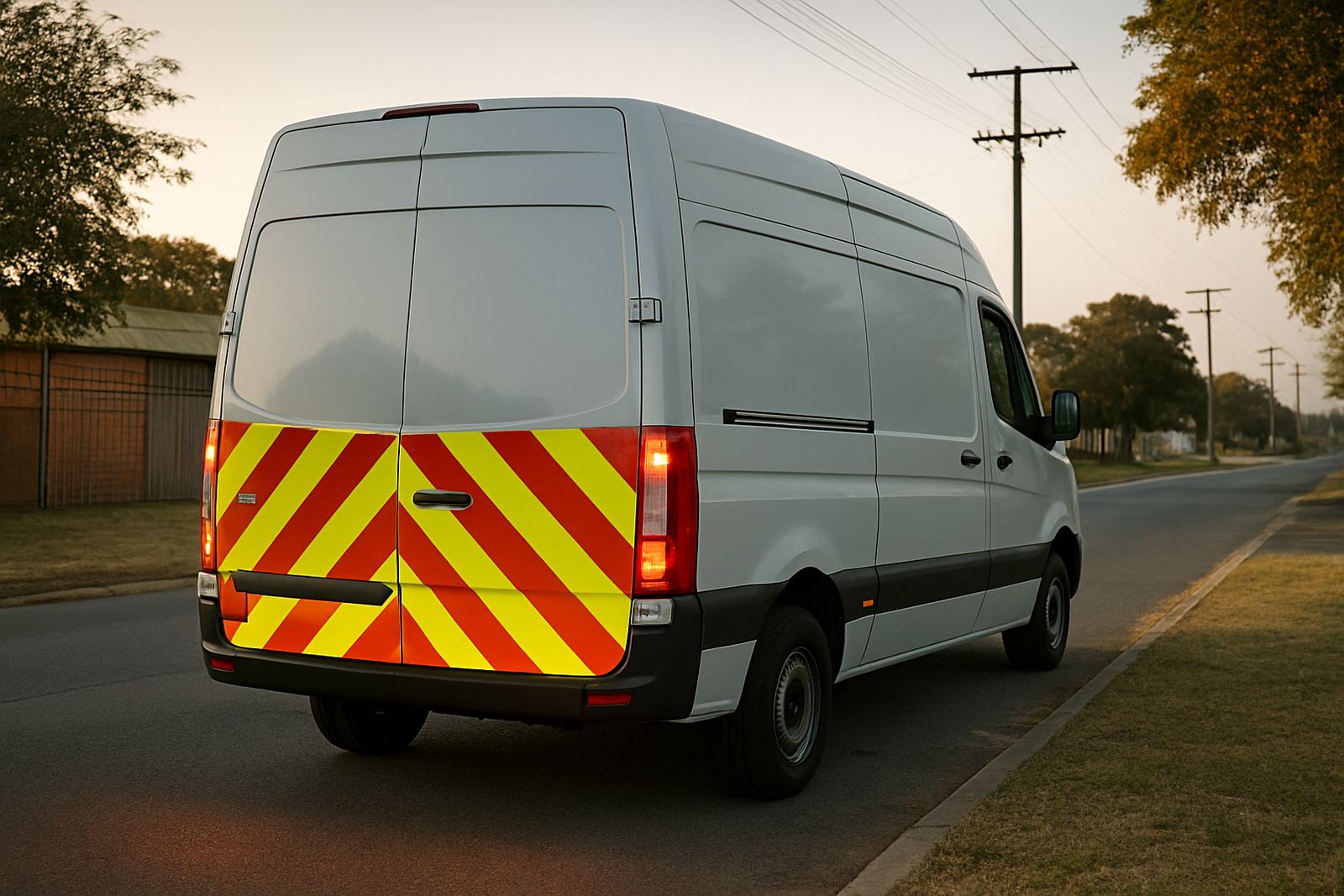
- Rear door chevrons or panels for delivery and service vans
- Side striping on bakkies and light trucks for easier recognition in traffic
- High-contrast fleet numbers for depots, yards and fuel checks
- Reflective door text for branded visibility at stops and in parking bays
For fleets that operate across Gauteng, reflective elements can support both branding and control. A vehicle with clear unit numbering and matching reflective line work is easier to track in a mixed fleet, especially when multiple drivers share the same vehicle during the week.
Safety gains that go beyond appearance
Reflective markings are often treated as a branding extra, but the safety side is just as important. When a vehicle is seen sooner, there is more time for following drivers to adjust. That matters most at dusk, in rain and in areas where street lighting is uneven. It also helps around depots where pedestrians move between parked vehicles, gates, bins and loading points.
For businesses that send staff out to customer sites, visibility can support safer roadside stops. A marked vehicle is easier to identify if it is parked on the shoulder, and reflective edges help it stand out from the road surface and surrounding clutter. This is practical in places like Kya Sand, along busy service routes, and on provincial roads where the shoulder may be narrow or poorly lit.
There is also a simple human factor. Drivers tend to take more care around vehicles they can see clearly. That small shift can help when staff are parking at warehouses, waiting at security gates or loading after dark. It is not a replacement for good driving, but it does support it.
Choosing the right reflective material and finish
Reflective work needs to suit the vehicle and the conditions it faces. On fleet vehicles that wash often, get used hard and spend time in sun and rain, the film has to hold its edge and stay readable. Coastal humidity can be tough on poor prep, while Gauteng sun can harden low-grade material quickly. A good job starts with proper cleaning, careful surface prep and a layout that avoids awkward joins around handles, seams and panel curves.
It also helps to think about maintenance. Some markings are easy to replace in sections, while full-panel designs can be more difficult if a bumper is repaired or a door is resprayed. The right approach should make sense for the whole life of the vehicle, not just the first month.
- Use contrasting colours that can still be read in traffic and at a distance
- Keep key details away from sharp edges and moving parts
- Plan for regular washing so dirt does not hide the reflective effect
- Match the design to the vehicle type, whether bakkie, van or light truck
A Johannesburg example: better night presence for a service fleet
One common local scenario is a small service fleet based in Kya Sand, with vehicles moving between Sandton, Randburg and Midrand after normal business hours. These vehicles often arrive at residential estates, office parks and industrial sites after dark. If the branding is too dark or too busy, the vehicle can disappear into traffic or a dimly lit loading area. A reflective layout on the rear doors, lower sides and unit numbers gives the fleet a cleaner road presence and makes each vehicle easier to identify.
That helps the business in two ways. First, clients can spot the correct vehicle quickly when it arrives at a gate or in a parking bay. Second, the vehicles are easier for other road users to notice in traffic. For a fleet manager, that is a practical return on a fairly modest investment, especially when the same vehicle is on the road six days a week.
In our experience, the most useful designs are often the simplest. Clean reflective striping, clear numbering and a tidy logo placement usually work better than a crowded layout. They look professional and they stay legible when the vehicle is dirty, which does happen on Gauteng roads and on long jobs.
How to make reflective markings work hard for your fleet
Reflective markings perform best when they form part of a wider fleet standard. That means consistent placement, repeatable colours and a clear rule for numbering across the fleet. It also means thinking about where the vehicles park, who checks them, and how often they are cleaned. If the markings are hidden under grime for most of the week, the value drops quickly.
For businesses with vehicles in different provinces, a standard approach makes life easier. A vehicle in Durban Service Area can still follow the same line work and numbering as one operating from the East Rand or Pretoria. That consistency helps with control, resale presentation and day-to-day recognition. It also makes it simpler to update or replace sections later on, without redoing the whole vehicle.
- Set a fixed placement for logos, unit numbers and reflective bands
- Keep a record of each vehicle’s marking layout for future repairs
- Review the condition of reflective film during routine servicing
- Replace damaged sections early before peeling spreads
For fleet owners, reflective markings are not just about looking visible. They help vehicles work better at night, support safer site movements and keep a business easy to recognise on the road. That is a useful combination, especially when the vehicle has to earn its keep every day.